



Around 14% of businesses in the US Retail Trade sector were using AI as of May 2026, against 19.8% of businesses nationally, according to the US Census Bureau. Meanwhile, the carriers those stores ship with already run AI on customs and routing every day.
AI shipping is the use of machine learning and AI agents to predict, check, and choose at the points where an ecommerce store's parcel costs are decided. It covers delivery dates, carrier choice, address checks, and invoice audits. It differs from AI in ocean freight, and from software teams "shipping" code, because it deals with parcels going to customers.
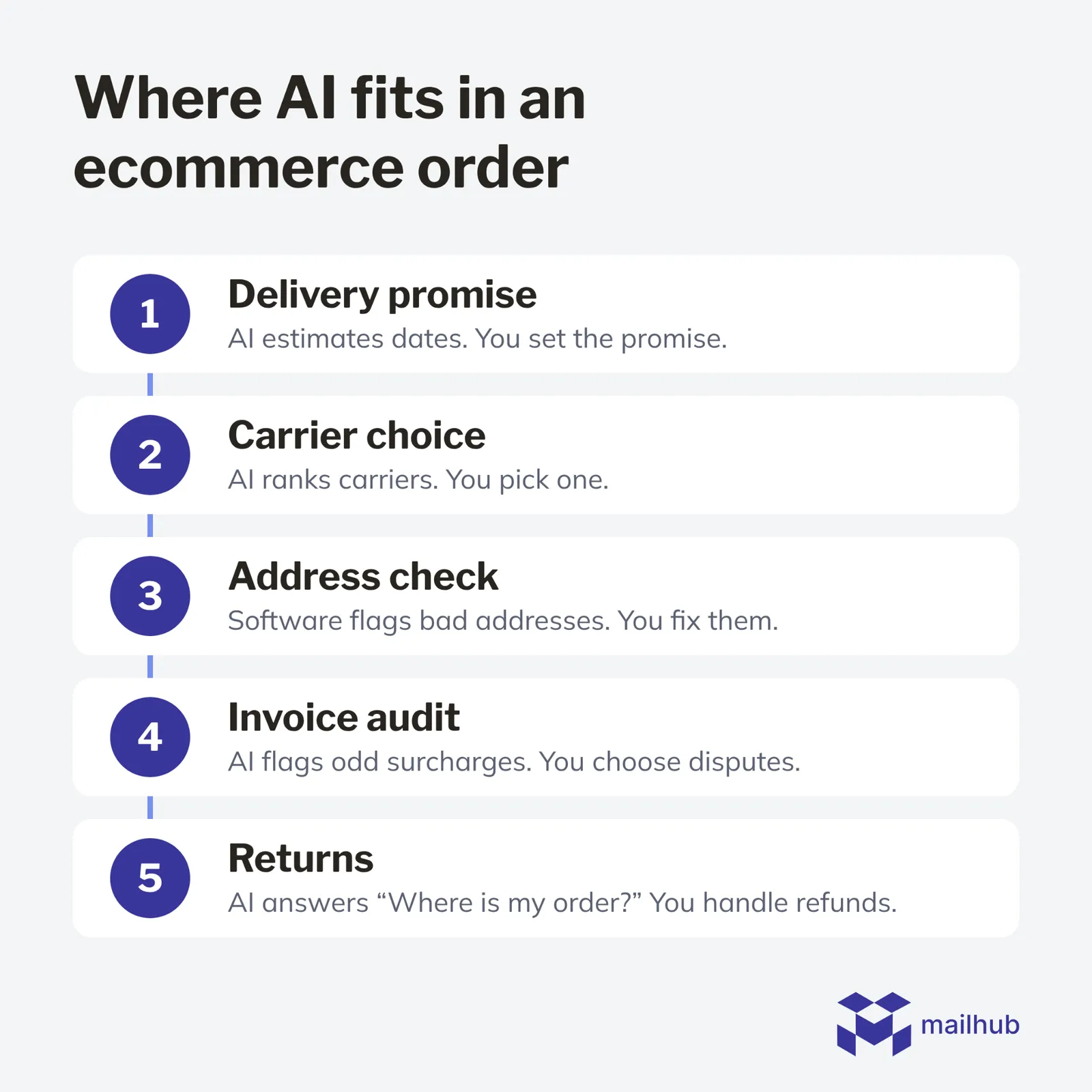
Shipping cost hides in the delivery promise, the carrier pick, the address, the invoice, and the return. That's where AI earns its keep, though for a small store each use is still early.
What does AI shipping do for an ecommerce store today?
AI shipping does five jobs for an ecommerce store today. It estimates delivery dates, ranks carriers and services, checks addresses before the label, audits invoices for surcharges, and answers post-purchase questions. Carriers and large shippers run versions of several, but for a small store each is still early, with limits to know before you trust the output.
Promising a delivery date at checkout
Carriers have predicted delivery dates with machine learning for years. USPS Advanced Expected Delivery, first tested in 2017, uses historical and real-time data to estimate when a package will arrive, according to the USPS Office of Inspector General.
USPS estimates can be adjusted as circumstances change, and the same report shows early predictions can be well off the mark. It puts the Universal Postal Union's machine-learning predictions for international mail at about 61% accurate when an item is posted, rising to 91% once it clears inbound customs. It gives no equivalent figure for US parcels, and a date shown at checkout is set before the parcel has even shipped.
You can show the carrier's own estimate at checkout today. Predicting dates with your own store-side AI model is still early. Build in a buffer, and decide yourself what checkout promises during peak weeks.
Choosing the carrier and service
Rate shopping across carriers is familiar. Carriers commonly use machine learning to predict delivery times, the inspector general's report notes, so a ranking can weigh those estimates as well as price. A ground service that arrives inside the promised window can then beat an express label bought out of habit.
Treat AI carrier choice as live but early: a ranking is only as good as the carrier estimates behind it, so keep the pick yours.
At Mailhub, we compare FedEx, USPS, and DHL on every parcel, rank them on price, and put the cheapest option at the top. The final choice stays with you.
Checking the address before the label is bought
A wrong or incomplete address becomes a correction fee once the carrier fixes it, and the charge reaches the shipper's invoice after the parcel ships. Carriers already validate addresses in their own systems; for a small store, an AI check before the label is live but early.
Address-correction charges in 2026: The UPS 2026 rate guide charges the shipper $25.25 for an address correction.
FedEx's 2026 surcharge and fee changes put it at $25.50 per correction, up from $24.
At UPS, 10 address corrections in a month add $252.50 to your invoice. A check reduces corrections rather than ending them: UPS states that an address it has validated may still be incorrect or incomplete for delivery, and may still be corrected.
Our shipping platform puts rate comparison, labels, and address validation in one place. The carrier checks every address when you buy the label, so a bad address is caught before the label prints.
Auditing the invoice for surcharges
The invoice is where the quoted rate meets the real one. Address corrections, residential and delivery area fees, fuel surcharges, and dimensional weight reassessments can all arrive weeks after you bought the label. That's how the invoice ends up above the rate you were quoted.
Automated audits exist at the enterprise end. Shipium, a shipping platform for large shippers, says on its website that it eliminates time-consuming tasks such as "invoice discrepancy analysis." For a small store, AI invoice audits are still early. Software can surface a charge that looks wrong; which ones to dispute is your call.
For larger shippers, we work earlier in the chain: our enterprise shipping shows the real cost per parcel, by pricing a shipper's own shipments before it commits.
Handling returns and post-purchase questions
In the FedEx Returns Survey, reported in February 2026, 37% of business shippers said they use AI tools for returns and 51% said they plan to, though FedEx doesn't state the survey's method.
In February 2026, FedEx made AI tools available to US enterprise customers, delivered with parcelLab, that automatically answer questions such as "Where is my order?" That's an enterprise offering, so for a small store this checkpoint is early, and refunds and exceptions need a person.
How are UPS, FedEx, and DHL already using shipping AI?
UPS, FedEx, and DHL already use AI in daily operations, mostly on work a store never sees: customs paperwork, route planning, and item descriptions for cross-border parcels. That means much of the AI touching your parcels already runs on the carrier's side, whatever tools your own store uses.
In March 2025, UPS cleared about 21% of 13,000 US-bound packages a day through customs without manual intervention. By September 2025, it was clearing 90% of 112,000 daily packages that way, Supply Chain Dive reported. CEO Carol Tomé said UPS had enhanced its customs brokerage "by integrating Agentic AI" to handle the extra volume after the US ended its de minimis exemption for low-cost packages.
FedEx uses AI route optimization to plan 100,000 first-mile and last-mile routes a day, according to Supply Chain Dive. It aims to have AI in more than 50% of its core operational workflows by 2028.
DHL Express turns a photo of an item into a customs-compliant description that the shipper can review, edit, or override, DHL says.
What changes when an AI agent can buy the label?
An AI agent that can buy the label can compare rates, pick one, and pay in the same exchange, so the real question is who approves the spend. Agent-driven label buying is live but early, and the answer to that question depends on how each tool is built.
UPS published an MCP (Model Context Protocol) server, the kind of connection an AI assistant uses to reach tools outside its own conversation. Its two tools, last released in July 2025, track packages and validate US and Puerto Rico addresses, and neither buys a label, according to its GitHub repository.
Through our remote MCP server, an AI assistant acting as the signed-in user can get carrier rates and buy a label for a chosen rate, as our MCP documentation sets out. The server refuses any purchase that doesn't carry an explicit confirmation. It's built into every Mailhub account, free, with nothing to request or enable.
Which shipping decisions should you hand to AI first?
The shipping decisions to hand to AI first are the ones where software checks your data without spending your money. The address check before the label comes first, because a missed correction costs more than $25 at UPS and FedEx. No checkpoint is yet proven common for small stores, so trial each one with a person approving.
The parcel cost checkpoint map rates each checkpoint by maturity and by who makes the final call.
| Checkpoint | What AI does today | Maturity | Who makes the final call |
|---|---|---|---|
| Delivery promise at checkout | Carriers estimate dates from past and live data; a store can show them | Live but early for store-side models | A person sets the promise |
| Carrier and service choice | Ranks carriers on price and estimated delivery | Live but early | A person picks the option |
| Address check before the label | Flags a bad address before purchase | Live but early | Software flags; a person fixes |
| Invoice audit for surcharges | Flags invoice discrepancies for large shippers | Live but early | A person picks disputes |
| Returns and post-purchase questions | Handles returns and answers "Where is my order?" | Live but early | A person handles refunds and exceptions |
Where should a person still make the call?
A person should still make the call wherever a shipping decision spends money, changes what a customer was promised, or challenges a carrier. Software can rank options and flag problems in those moments, but you pay for every wrong answer, so sign off before the decision becomes final.
Keep these calls with a person:
- Buying the label. Whether you pick the carrier or an agent proposes the purchase, confirm the choice and the spend before it happens.
- Changing the delivery promise. A date shown at checkout is a promise to your customer, so own how much buffer it carries in peak weeks.
- Disputing a carrier charge. Software can spot a surcharge that looks wrong, but you decide which disputes are worth the time and the carrier relationship.
What should you ask before trusting AI with your shipping?
The questions to ask before trusting AI with your shipping cover where its data comes from, what its prices include, and who approves a purchase. Put them to any tool or vendor before it touches a label, a delivery promise, or a carrier dispute.
- Does the delivery estimate come from the carrier or from the tool's own model, and is there a published accuracy figure?
- Does the price shown include the charges that land after the label, such as residential, delivery area, and address-correction fees?
- Can an AI agent buy a label without a person confirming the purchase?
- Is the final carrier choice yours, or does the tool make it for you?
- When a prediction is wrong, who catches it, and who pays for the fix?
Frequently asked questions about AI shipping
Is USPS using AI?
USPS is using AI across its operations. The USPS Office of Inspector General counts more than 35 approved or in-testing use cases, from address recognition to customer assistance chatbots, and says automated address reading reaches nearly 100% accuracy. That accuracy is about reading an address, not about whether the address is right.
Is AI replacing logistics jobs?
Logistics jobs are shifting toward overseeing automation at UPS, which calls the change upskilling. CEO Carol Tomé told Supply Chain Dive that "someone's going to have to oversee the robots." Across all sectors, the U.S. Chamber of Commerce Foundation found only 6% of small-business workers who use AI say they automate workflows with minimal human involvement.
Can AI find the lowest-cost shipping option?
Yes, AI can find the lowest-cost shipping option if you give it what carriers price on: package weight and dimensions, origin and destination ZIP codes, whether the address is residential, and the delivery date you need. Ask for the total with surcharges included, and compare only services that arrive by the same deadline.
Is AI shipping the same as AI dropshipping?
No, AI shipping and AI dropshipping are different things, despite the similar names. AI shipping uses software to predict, check, and choose how a store's parcels are sent. AI dropshipping uses AI to run a store whose suppliers ship straight to customers, so the store never holds stock.
Let AI find the hidden costs and keep the spending decisions yours
The places AI shipping pays off are the ones where shipping cost hides, from the address on the label to the surcharges on the invoice. For a small store, the address check is the easiest place to begin: software flags the problem and spends nothing doing it. Keep every decision that spends money with a person.
At Mailhub, we show what your parcels really cost across FedEx, USPS, and DHL on one screen, with no monthly fee. Sign Up Free to see your own numbers.